Gods of the World

Gods of the World

Tuesday, August 09, 2011

Market crash 2011... Don't say I didn't tell you so...

Well since the markets has recently confirmed my view in June and is heading to the Dow 10000 level that I predicted, Im going to post on this blog a part of my QE3 publication that I wrote at the end of June. Even though I was wrong on the treasury call, I was definitly good on the equity trade. Here it is:


So as we approach the end of June in a couple of days, the Fed’s QE2 600$ Billion purchase program is coming to the end but we just had the 10 year yields breaking below 3% again today with the help of a 1 trillion $ US equity market correction in the first 2 week of June. This begs the question, is Bill Gross right with his call to underweight US treasury?


Well for those of you that are unfamiliar with the bond market (which you really should be since the bond market basically tells you if the equity markets will head up or down), the king of PIMCO is arguing that US treasuries are overpriced, it is the wrong bet and that he is underweight in US sovereign for a few reasons (FYI, I completely agree with him even though the bet is wrong at the moment). First, we focus so much on the nation’s 14.3$USD trillion public debt that most of us are forgetting about the American Ponzi Scheme with Medicare, Medicaid and Social Security that is putting America on the tab for close to 100$USD Trillion in unfunded liability. Second, with the Fed’s expansion of balance sheet ending, who is going to continue with the treasury buying? This again leads us to the question of the extension of the debt limit and the possibility of QE3.

We all know QE2 completely bombed, everything the program was supposed to accomplish failed, money are moved from the FED into risky asset, equity markets gets inflated and huge pile of cash goes into speculation that leads to commodity inflation which in turns adds pressure and slows down the economy. While all the cash is getting piled in to give LinkedIn a ridiculous valuation of 10$ billion at the first day of trading (which sales is only at 250$M), none of the money moved into the economy and nothing work! Just look at all the economic numbers! By the way, and its not that banks are unwilling to lend out their reserve from QE2 to small businesses, far importantly, the problem is that they are unable to. You know why? Because all of the actual QE2’s liquidity went to the rescue of foreign banks! Ask big Ben Bernanke and he will explain that to you.

So, is Bill Gross right? I think so. And if we do see QE3, what will happen in my point of view? Stagflation. Let me remind you of the Japanese Economy after their failure of their QE in early 2000. Decades of deflation, 13$USD Trillion in debt, debt to GBP of 200%, 2 year yields at 0.1% and here is a Nikkei 225 historical chart to better paint your memory (chart below). You can't cover a huge wound with a band aid, all it does is it delays the problem. One band aid (QE) after another, eventually, if you don't stitch the wound ( increase taxes, increase saving, balancing budget) it will just get worst and infected as you keep covering it up with more band aid. Stiching the wound will be painful for the whole country, but its the right thing to do, or else, eventually, you will bleed to death. So US equity market and economy? Say goodbye to that…Remember, the lowest the Dow hit in the recent crisis was around the 7000 level, we have a long way down to go...


Monday, August 08, 2011

Im back....Since S&P is doing the useless downgrading anways...

Here, since I am currently preparing to write about how the power of the world is about to shift from a single dominant power back to a system of balance of power (like in Europe for the past centuries), here are two interesting charts, one on global arms exports and the other comparing the military power of China and the US.


By the way, like I called it, we should see the US market dip ( I called Dow 12000 the shorting point and those of you that listened, you are well in the money with shorting the YM futures, but please, keep riding this trend and slam the whole thing down, we don't get much of these opportunities) and there will be no QE3 package in the US as it is a suicide pill that will take the country into stagflation if it doesn't work. Uncle Ben is a student of the great depression and he understands the consequences of failure. He knows how painful the lost decade was for the Japanese and he won't risk the US economy into the same black hole. ECB is the only one that can push though a QE1 for them and we are seeing it as they are starting to pick up all the EU bonds in the secondary markets these days.

And the S&P downgrade, what kind of BS is this anyways? Its not like we don't know the US's balance sheet is crap, we know this for decades. There is 14Trilion of debt and like 70 Trillion of unfunded liabilities, we all know that, its not a secret. Why a downgrade all of a sudden? Its so useless! They have the currency reserve, as long as they keep it, it doesn't matter what your downgrade is, even at BBB, the 10 years still trade below 2.7%, so what a bunch of non sense...

Tuesday, June 21, 2011

Goldman Sachs, the story of the survival of the fittess...

Its been a while since I last wrote an article about credit derivatives so here, this article is for all you quant nerds....lol... Well, let me begin with two random quotes from Goldman's management during 2007 right around the time when the ABX BBB index faced an initial decline in December 2006:

" Sell what could be sold as is, repackage and sell everything else " - Keven Gasvoda, MD, Goldman's Fixed income, Currency and Commodities.

"We have been thinking collectively as a group about how to help move some of the risk. While we have made great process moving the tail risks, we think it is critical to focus on the mezz risk that has been built up...the best target, would be to put them in other CDOs"- Stacy Bash Polley, Co Head of Fixed Income Sales.


Goldman had it all figured out before anyone else even had a clue what was going on. Goldman is smart, the team is damn smart. They are the king of repackaging, from MBS to a CDO, from a CDO to CDO squared, they are the best, thats it! In 2010, after getting nailed with a 550$ million settlement for the Abacus synthetic CDO deal involving Paulson (who actually just lost 750$ million today by dumping all his share of Sino Forest, its his turn to get screwed this time) we have here a post by William Cohan about the credit derivative business at Goldman Sachs:

"Goldman's business model is designed around the exploitation of secrecy. Secrecy is organizing principle that governs modern credit markets. Credit default swaps, privately placed structured securitizations (e.g. CDOs), and hedge funds have all flourished-- they dominate the debt markets--because they are all designed to exploit secrecy. They all create extraordinary profits by keeping the rest of us in the dark. So in late 2006, if you wanted to find out what was happening in this newly created synthetic RMBS market, you couldn't find out much of anything. You couldn't find out anything about who bought or sold any CDO, or what was in any CDO, or how any CDO performed, unless Goldman or some other CDO underwriter deemed you sufficiently worthy of their selective disclosures. You couldn't learn anything from the sales or trading activity of mortgage bonds, because the related trading in credit default swaps was kept hidden beneath the surface. You didn't know anything about the trading activity related to the ABX indices, since that, also, was kept secret. And since the privately-held company that owned the ABX, CDS IndexCo LLC, operated in total secrecy, and since the privately-held company that published the price of the ABX, Markit Group Limited , operated in total secrecy, you had no way of knowing the extent to which the price of the ABX was manipulated through round-tripping, side deals with synthetic CDOs, or anything else. The only thing you knew, your only link to the illusory "reality " of market sentiment, was the quoted price of the ABX. And you might happen to know that the Chairman of CDS IndexCo was Brad Levy, a managing director at Goldman, which, along with a handful of other banks, controlled CDS IndexCo and Markit Group. Both the FCIC and the Levin subcommittee disclosed a wealth of information that others with a more skeptical bent can scrutinize in depth. This information poses a direct challenge to Goldman's dissembling, and to the moral hazard of access journalism, which is no substitute for the full transparency of a free and open marketplace of ideas. "


Well here you go, so whoever that wants to argue with me in regards to why Goldman is the best in the business, give me a call.. I'll be more than glad to. And to sum up, here is a diagram of the famous Abacus AC1 Syntheic CDO deal, talk about confusing the hell out of everyone....


Friday, June 17, 2011

Morgan's call on a 7s-10s DV01 flattner by Jim Caron

Here is a very good article from Zero Hedge for those of you that follow and trade the interest rates markets. FYI, I think that this 7s 10s flattener is a good relative trade idea since its better than going direct short on the 10s , but Caron's reason of trade ( economic growth ) vs Bill Gross's claim ( lack of Fed buying at the end of QE2) is completly INSANEEEEE. Anyways, here is the article...

It has not been Jim Caron's decade. The Morgan Stanley rates strategist, riding on the coattails of the always wrong Morgan Stanley economics team led by David Greenlaw, has been wrong in his annual rates call year after year after year. Which is unfortunate because while unable to see the forest for the trees, Caron does have a better grasp of rates than most other Wall Street penguins. That said, just like everyone else in the status quo, Caron has just come out with another short duration call (i.e. sell bonds), probably the 6th time in a row he has done that in the past 3 years. Perhaps 7th time will be the charm. Amusingly, Caron, terrified to be seen in the same camp as Bill Gross who is short bonds on fears that there will be nobody available to step in an buy the 80% of gross issuance that has been monetized by the Fed to date, make this very loud caveat on his short bond call: "To be sure, our shift toward short from neutral duration has nothing to do with the end of QE2 and related concerns that there will be a lack of demand to buy US Treasuries once the Fed stops buying them. As we have stated many times in the past, the outlook for the economy will be the main driver of yields, not the end of QE2." No, instead Caron believes that the sell off in bonds will be due to the same bullish economic growth call that he has been predicting over... and over... and over... and over... etc. More interesting is how he suggests the trade is implemented: in MS' view the best way to be bearish on rates is with a DV01 neutral 7s-10s flattener: "we continue to recommend being short 5s on the 2s5s10s fly. In line with the butterfly, and in order to express a more robust short duration position, we recommend a curve flattener on the UST 7s10s curve: · Sell $133.7mm OTR 7y Notes; · Buy $100mm OTR 10y Notes." Perhaps those who want to be short bonds, but for the right reason, that predicted by Zero Hedge and then Bill Gross, this may be one of the better ways to put the trade on.


And the best way to express a bearish stance in the rates complex according to Caron:
Since April, the belly of the curve has richened significantly as rates have marched lower (Exhibit 1). We continue to recommend being short the belly vs. the wings, as previously discussed short 5s on the 2s5s10s fly (see “Fade the Recent Outperformance of  the Belly,” US Interest Rate Strategist, June 9, 2011). In line with the butterfly, and in order to express a more robust short duration position, we recommend a curve flattener on the UST 7s10s curve:

· Sell $133.7mm OTR 7y Notes

· Buy $100mm OTR 10y Notes

Both the 7s10s curve flattener and the butterfly allow the investor to play for a reversion in the richness of the belly. Rather than going outright short we suggest initiating these relative value trades, which capture some duration exposure and some relative  value exposure between different points on the curve.

We argue that growth expectations have not been downgraded to the extent that rates in the 5-10y sector have fallen with survey consensus at 3.35% for 2H11. In our view, the rates market is pricing levels of US growth that are inconsistent with surveyed forecasts (see “Reducing Duration Exposure from Neutral to Underweight” in this publication).

This past week, price action in the market has reflected uncertainty as, for example, the 7y point increased 12bp on Tuesday only to decrease by 14bp on Wednesday returning to similar levels. We expect the market to remain range-bound in the near term; however, we see fair value of the 10y note at about 3.10% with a 25bp standard deviation (Exhibit 2). With the 10y dipping to the low 2.90’s, we see an opportunity to fade this extreme.


Wednesday, June 15, 2011

Fannie, Freddie, Ginnie and all about that government crap...

So, market crash in 2008, who is to blame? We've been though this one many times, some blame the shadow banking system, some blame deregulations, securitizations, other point their fingers at Greenspan while many are holding a knife at the doors of the credit rating agencies. Well, in my view, they all play a huge role but today, I want to write about the three government giants, Fannie, Freddie and Ginnie because many people don't seem to have a clue what they do and where they come from other than the fact that they deal with mortgages.

Fannie Mae was chartered by the reconstruction finance corporation during the great depression in 1938 to buy mortgages insured by the FHA. Back in the day, Fannie either held the mortgages they bought in its portfolio or they simply resold them to thrifts, banks, insurance companies or investors at a later time. The model worked fine but there was one major issue with this system. Fannie Mae, in order to buy these mortgages, they did it by borrowing the money. In 1968, the mortgage portfolio of Fannie had grown to 7.2$ billion USD and the government started to notice this issue. So in order  to get the debt off the government’s balance sheet, president Johnson’s administration reorganized Fannie as a publicly traded corporation and created Ginnie Mae to take over Fannie’s subsidized mortgage program and loan portfolio and this was how Ginnie Mae was created.

Two years later, the thrifts and banks persuaded congress to charter a second GSE and Freddie Mac was created to help the thrifts sell their mortgages once again. Like we mentioned in the beginning, before 1968, Fannie Mae held the mortgages it purchased, profiting from the spread between its cost of funding and the interest paid on the mortgages. The new laws in 1970 gave Ginnie, Fannie and Freddie the option of securitization. So yes, in my point of view, the most early build up of the 2008 crisis can even start from as early as here. Therefore in 1971, Freddie got into the business of buying mortgages, pooling them and then selling MBS to investors. They did not originate mortgages, they bought them from banks and mortgage companies; either held them in the portfolio or securitized them and guaranteed them. The entire business model was changed.

The new laws in 1970 not only gave Freddie the option of securitization, but it also set the government sponsored enterprises’ minimum capital requirement at 2.5% of asset plus 0.45% of the MBS they guaranteed. Do you even know what kind of leverage this is?  They could borrow more than 200$ for each dollar of capital that was used to guarantee the MBS. If they owned the securities, they could borrow 40$ for each dollar of capital. Combined, they owned or guaranteed 5.3$ Trillion USD of mortgage related assets at the end of 2007 with only 70$ Billion USD in capital! This is a leverage ratio of 75:1! Talk about risk! The Basel accord is also to blame for this! The leverage ratio of the five major investment banks in 2007 were as high as 40 to 1, and you have the government leveraging at 75 to1. Ridiculous! So now you get why these guys didn't work out! A private business with a goal to maximize shareholder equity with the backing of the government, I don't think Johnson thought this one out too well back in the 60's!

Monday, June 06, 2011

Update with the birds at the FED: SocGen


Below is a summary of recent Fedspeak:
Bernanke – QE2 will be completed, but very little chance of QE3 as the trade-offs are unfavorable. Inflation expectations are still in comfort zone, but continue to watch very closely.

Pianalto – Labor market remains a long way from healthy. Looking at just above 3% GDP growth over next few years. Will take about 5 to 6 years for unemployment rate to reach NAIRU (5.5 to 6%).

Kocherlakota – Fed should raise the Fed funds rate by 50bps in 2011. Rate hikes hinge on his forecast for core inflation averaging 1.5% for rest of year. Rate hikes should be first move in exit strategy. Extended language means 2 to 4 meetings.

Lockhart – Extended period change hinges on Unemployment. Job progress slow and inflation transitory. QE3 probably unnecessary. Inflation will move to about 2% in two years.

Lacker – Inflation expectations at the upper end of the Fed’s comfort zone. Recent surge in commodity prices likely temporary. After QE2 focus shifts to timing and speed of stimulus withdrawal.

Bullard – Fed may put policy on hold to ensure economic recovery is gaining ground. Does not give judgment whether he agrees with this. US can weather recent oil price shock.

Dudley – Time to act is now. Current levels of inflation and unemployment and timeframe to return to mandate unacceptable. Showed support for price level targeting.

Evans – Believes that Fed needs to buy at a large scale several times. This would support a price level target to make up for the shortfall in Inflation. Strong support for price level targeting.
And as a bonus, here is SocGen's current set of assumptions for the chronology of Fed exit steps:
1. End of QE2 The April FOMC statement confirmed that QE2 will end on schedule, after reaching the $600bn target. This will mark the official end of the Fed’s easing cycle. When? June 2011
2. Halting MBS reinvestments Bernanke noted in its April FOMC press conference that halting MBS reinvestments will most likely occur early in the exit process. Fed will probably wait a few months following the end of QE2 to assess the impact before taking this next step. When? September 2011

3. Liquidity draining operations We believe this has to be done ahead of rate hikes, or else the effective fed funds rate will trade away from the target. The Fed could use a combination of reverse repos, term deposits and possibly restore the Supplemental Financing Program  (subject to Congress increasing debt ceiling). When? November 2011

4. End of “extended” language The Fed has previously suggested that the extended language means about 6-9 months. Given the timing of our rate call, the phrase should be dropped around the turn of the year. When? December 2011

5. Rate hikes Our call is for mid-2012, with a bias toward the third quarter. When? Q3’2012

6. Asset sales We believe that outright asset sales will begin around the time of the first rate hike. Fed has indicated a goal of returning the size and composition of its securities portfolio to pre-crisis trend over 5 years. We believe they will start by selling about $10bn per month. When? Q3’2012

Tuesday, May 31, 2011

Update: China SAFE Report

From Zerohedge: China's State Administration of Foreign Exchange (SAFE) has released its breakdown of 2010 international investments. In summary: financial assets abroad rose 19% last year to $4.126 trillion from $3.457 trillion. That includes the country's $2.914 trillion of foreign reserves at the end of 2010 as well as other assets such as direct investments, securities, and gold. As for gold, it increased by $11 billion from $37.1 billion to $48.1 billion, or a 29.6% increase (it is unclear if this number is at a fixed gold price or accounts for MTM). On the liabilities side, which increased from $1.946 trillion to $2.335 trillion, the biggest change was as a result of a surge in Foreign Direct Investment into China which increased by $162 billion to $1.476 trillion. Netting liabilities against assets leads to a net position of $1.79 trillion in external net assets.

Full breakdown of China's foreign-held stash:

Wednesday, May 18, 2011

The History Of The World's "Reserve" Currency: From Ancient Greece To Today

This is probably one of the most educational article that I came across in a long time:

Probably the most interesting part of the previously discussed 174-page World Bank report on the future of world currencies, is, ironically, the part that deals with the past. In its discussion of why "Historically, one national currency has played a global role—or at most, a few national currencies", the WB analyzes the history of the "reserve" or dominant currency from ancient times, through today. It is an engrossing narrative which ebbs and flows with the rise and flow of the dominant superpower (no surprise there). The bottom line of course is whether or not the US will retain its superpower status in an increasingly multipolar (and developing-led) world. And whether it will be replaced by China...or nobody. The implications for the next reserve currency of choice are substantial.

Historically, one national currency has played a global role—or at most, a few national currencies
Historical records indicate that the silver drachma, issued by ancient Athens in the fifth century B.C.E. was likely the first currency that circulated widely outside its issuing state’s borders, followed by the gold aureus and silver denarius coins issued by Rome, even though the Athenian and Roman currencies circulated simultaneously for some time (see figure B3.1.1). The dominance of the Roman-issued coins was brought to an end as the long cycle of inflation that characterized the economy of the Roman Empire from the first century C.E. through the early fourth century led to a continuous devaluation of the Roman-issued currency, causing it to become increasingly less accepted outside the Roman Empire. Ultimately, the aureus became valued according to its weight rather than its imputed “face value,” trading more as a commodity than a currency outside the Roman Empire and making way for the Byzantine Empire’s heavy gold solidus coin to become the dominant currency in international trade in the sixth century.

By the seventh century, the Arabian dinar had partially replaced the solidus in this role, although the solidus continued to circulate internationally at a debased value (reflecting the high financing needs of the Byzantine Empire) into the 11th century. Large fiscal costs also led to a gradual devaluation of the Arabian dinar starting at the end of the 10th century.

By the 13th century, the fiorino, issued by Florence, was widely used in the Mediterranean region for commercial transactions, only to be supplanted by the ducato of Venice in the 15th century. In the 17th and 18th centuries, the dominant international currency was issued by the Netherlands, reflecting that country’s role as a leading financial and commercial power at the time. At that point, paper bills began replacing coins as the international currency of circulation, even though they were not backed by the Dutch government or any other entity under sole sovereign control.

It was only when national central banks and treasuries began holding gold as reserves, beginning in the 19th century, that bills and interest-bearing deposit claims that could be substituted for gold also began to be held as reserves. This development coincided with the rise of Great Britain as the leading exporter of manufactured goods and services and the largest importer of food and industrial raw materials. Between the early 1860s and the outbreak of World War I in 1914, some 60 percent of the world’s trade was invoiced in British  pounds sterling.

As U.K. banks expanded their overseas business, propelled by innovations in communications technology such as the telegraph, the British Pound was increasingly used as a currency of denomination for commercial transactions between non-U.K. residents—that is, the pound sterling became a more international currency. This role for the pound was further enhanced by London’s emergence as the world’s leading shipper and insurer of traded goods and as a center for organized commodities markets, as well as by the growing amount of British foreign investment, of which a large share was in the form of long-term securities denominated in pounds sterling.


At the beginning of the 20th century, however, the composition of foreign exchange holdings by the world’s monetary authorities began to shift, as sterling’s share declined and the shares of the French franc and the German mark increased. The beginning of World War I in 1914 is widely viewed as signaling the end of Great Britain’s leading role in the international economy and the breakdown of economic interdependence.

Despite attempts to revive the gold exchange standard after World War I and to restore an international monetary order based on fixed exchange rates, the restored system lasted only a few years. The U.S. dollar’s use internationally as a unit of account and means of payment increased during the interwar period, particularly during the 1920s, reflecting the growing role of the U.S. economy in  international trade and finance. Although gold was officially the reserve asset (and the anchor) of the international monetary system following World War II, under the Bretton Woods system of fixed exchange rates, the dollar took on the mantle of dominant international reserve currency. By the early 1970s, however, following the breakdown of the system because of its inherent Triffin dilemma, the major economies moved to implement floating exchange rates.

During the 1980s, the global economy showed indications that it was moving to a multicurrency system in which the Deutsche mark was taking on an expanded role as a key currency, both in Europe and globally. This was due to a combination of factors—low and stable German inflation; credible government policies; deep, broad, and open financial markets; and a relatively high share of differentiated  manufactured exports in Germany’s trade. The introduction of the euro in 1999 and its adoption by a growing number of EU countries in the intervening years has only revived the debate about the dollar’s future role as the dominant international currency.

Monday, May 16, 2011

Chinese Bond Auctions Fail... Not one, but two?

Zerohedge today: And while the US is no longer allowed to auction off debt, in China the PBoC appears to be no longer able to auction off debt. As Business China reports, "the central bank scheduled the auction of RMB 20 billion worth of one-year treasury bonds and RMB 10 billion in six-month bonds on the country’s interbank bond market for May 13. But banks, faced with tight liquidity, only purchased RMB 11.71 billion worth of one-year bonds and RMB 9.63 billion worth of six-month bonds, the report said." In other words, there was a nearly 50% miss on the 3 month auction.

The key reason: "The reference yield of one-year treasury bonds was raised to 3.0246% from the previous issuance, while the bond yield of 182-day discounted treasury bonds was 2.91%, the paper said." It appears investors don't agree with the central planners that 3% is an appropriate rate to compensate them for surging inflation. That, and also the fact that banks suddenly have no liquidity: "Tighter liquidity was behind the under-subscription, as the central bank resumed selling three-year notes on May 12 after a hiatus of more than five months, a bank analyst who was not named was cited as saying. The central bank also raised banks’ RRRs by 0.5 percentage points on the same day, effective May 18, the fifth consecutive month its has raised RRRs this year." And so the Catch 22 emerges: the more China fights inflation through RRR or rate hikes, the lower the purchasing power of domestic banks to purchase bonds (and yes, the US deficit is just a few hundred billions dollars too wide for it to come to China's rescue). Should the "15 minute" inflationary conundrum continue to express itself, and China be forced to rise rates even longer, very soon the country, just like the US to which it is pegged monetarily, will also be unable to raise any incremental capital.

Saturday, May 14, 2011

The End of the USD Depreciation: Part II

Over the past couple of days, I received a few calls and email from some of you asking about my Yen/USD trade idea that I mentioned in my previous post, for those of you that didn't get the quarterly publication, here was the FX trade strategy that I wrote up back in April:

First off, I will start with some history and fundamentals for those of you who aren’t active in the foreign exchange market. The popularity of the USD/JPY trade has come a long way. In the 1980s, during the Carter and Reagan era, the US was going though a time of high inflation and high interest rates and the Americans were unhappy with the strength of the USD (1 USD = 260 JPY) so during the Plaza Accords, James Baker and the Japanese government agreed to let the USD freefall against the JPY. The JPY settled at around 130 JPY/USD in 1990 and this let to huge strength for the Japanese economy. Along with deregulations in the Japanese financial industry and speculation of the housing market supported by the government, the real estate bubble exploded, banks that were “too big to fail” went under and it drove the Japanese economy into the lost decade (Doesn’t that sound similar to subprime 2008 huh?). This was when the original quantitative easing tool was first applied to fight the severe recession. For over two decades, Japanese’s bond yield hovered near 0% and therefore it was very popular for traders to build carry trades with the USD/JPY pair due to the carry from the interest rate differentials.

So, what is a carry trade?  In a carry trade, an investor borrows in a currency with low interest rates and re-invests in a currency with higher yield. But in 2010, due to the appreciation of the JPY (if you read my previous papers you would know why), which had a 15% gain versus the USD, those who pursued a yen based carry trade strategy suffered huge losses on their P&L. (Below is a table explaining the JPY based carry trade with the 2011 YTD return and the last 12 month’s return)


I mentioned to many of you that when the JPY broke 80 against the USD last week, the appreciation of the Japanese Yen is coming to an end, especially against the USD and EUR. Not long ago, the Japanese government intervened to depreciate the currency to support its economy, but as we all know, that didn’t last too long before the climb continued. However, this time around, it’s going to be different due to two main reasons:

  1. Interest rate differentials from the inflation pressure at the FED and ECB
  2. The reversal in trend of monetary base due to the recent earthquake.


Inflation: if we take a look at the global economic situation, central banks are facing growing pressure to tighten up monetary policy from the inflationary pressure. The CPI projection for 2011 in the US is at 2.7, the CPI for the Euro Zone is near 2.5 while the Japanese CPI is projected at 0.1. Not only is food inflation creating a problem, the expansion of balance sheets due to the recent financial crash are forcing the long term yields to rise. Rates are at their historical lows for the FED and the ECB and the market has already priced in for the Fed to shift 25 bps by Aug 12th and the ECB to equally shift 25bps by April 11th. Now, as the Japanese economy remains deflationary in 2010 and 2011 (FYI, Japan’s core CPI excluding energy and food fell 0.7% year over year in December 2010)  this earthquake will only force the BOJ to keep rates at this historical low to boost economic development. For those who are active in the F/X market, the two year US/Japan swap rate differential moved from the low of 9bps to 46bps today.

Monetary Base: interest rate differential and the Japanese/US Monetary base ratio are two main macro factors that explain the currency movement between the two countries. While the FED expanded its balance sheet to about 2.5$USD Trillion with the two QE programs, the purchases is expected to end in June and we will most likely see the Fed reversing its actions to reduce the monetary supply in the system. Before the earthquake, the ratio of the Japanese monetary base to the US settled at 51.8 at the end of 2010. After the earthquake, the BOJ decided to increase the size of its asset purchase program to 40 Trillion Yen and this will boost its monetary based by 5% while the Fed is expected to do the contrary in June. Based on a simulation done by Bloomberg, this will reverse the recent decline of the ratio from 45.1 in February 2011 to about 48.1 when the BOJ purchase will be completed. Last and not least, on March 18th, the G7 central banks coordinated an effort to flood the Yen in the global market by injecting 15 Trillion yen to stop its appreciation (So for you smart ones, hope you figured that there is a floor here!).

Thursday, May 12, 2011

Dylan Grice On The Coming Japanese Hyperinflation

So here is a resume from zerohedge and a chart from one of my favorite, Dylan Grice from SocGen in his paper about his views on the upcoming Japanese Hyperinflation:

To those who follow Dylan Grice's writings closely (and everyone should), his proposal that the only possible outcome for Japan, where stunningly tax revenues no longer ever cover non-discretionary expenditures - a sad fate that awaits none other than the US eventually, is to hyperinflate its way out, is not new. Nonetheless, during the just completed annual CFA Institute annual institute held in Edinburgh, he gave an updated presentation which indicates that he has not yet changed his opinion that if forced to pick between the lesser of two defaults, the only option is that of unbridled printing, now that the US has firm leg up in the global fiat race to the currency bottom, which we predicted back in 2009, will be the key feature of the macro theme until the end of the Keynesian experiment. So, as before, Grice's recommendation, away from the natural trade of shorting bonds (a negative carry trade which has cost the likes of Kyle Bass a pretty penny over the years) as one awaits this only possible outcome, is to actually discount the future, something the market has completely forgotten how to do, and buy stocks, in advance of the Weimar Rally for the Rising Sun. Below we present "Hoping for the best, preparing for the worst...in Japan" - Grice's presentation of an upcoming Japanese hyperinflation, which explains not only why Japan can't afford higher JGB yields, but why its to-date favorable demographic are now looking uglier by the day, and the only outcome for Shirakawa is to finally bite the bullet and beat the Chairsatan at his own game, in the process forcing the Bernank's own hand if he wishes to retain the USD's place at the head of the FX devaluation race.
 
For the really ADHD afflicted, here is the "CDS trader" abridged version:
  • Japan’s unprecedented predicament: A large creditor nation, a bankrupt government, and a shrinking population
  • Competing forces in the hyperinflation template: An unsustainable public debt profile with persistent current account surpluses
  • Protecting portfolios: How investors can cheaply hedge against the risk of an extreme scenario

CHART 1: Japanese government tax revenues no longer cover discretionary expenditure:


Tuesday, May 10, 2011

So, is this going to be the end of the USD depreciation?

Well here are 2 charts posted by Bloomberg today. If you read my articles in April about the USD/YEN trade recommendation, you'll know what I am talking about...

Monday, May 02, 2011

Treasury Cuts Its Borrowing Need Estimate By Half, To Suspend State, Local Gov't Funding Due To Upcoming Debt Ceiling Breach

Here is a pretty interesting article posted by zerohedge today: After announcing it issued $265 billion in marketable debt to fund $445 billion in financing needs (including the wind down of $195 billion in SFP cash management bills), the Treasury has just announced it expects to need just $142 billion in Treasury issuance in the April-June quarter. This ridiculous amount is more than 50% lower than the previous estimate of $299 billion disclosed on January 31, and confirms that the Treasury is now scrambling to appear prudent to Congress with its debt needs. That it will need far, far more at the end of the day is beyond question. The reason for the over 50% plunge in borrowing needs "largely relates to higher receipts and lower outlays." Well, that's great - perhaps the treasury can explain why its preliminary cash need for the July-Sept quarter are $405 billion (compared to $396 billion a year earlier). Altogether, this advance estimate is ludicrous and shows that Geithner has totally lost a grip on reality. Yet on the other hand, in order to make his point, the market needs to crash (just like the May 6th crash killed any hope of an Audit the Fed bill). Looks like risk is duly nothing its duty to act appropriately when record 2011 bonuses are at stake.


Here are some parts of the letter from our man Timmy Geithner since its too long to post the entire thing:

"In my last letter, I described in detail the set of extraordinary measures Treasury is prepared to take in order to extend temporarily our ability to meet the Nation’s obligations if an increase is not enacted by May 16, when we estimate the limit will be reached.  Because it appears that Congress will not act by May 16, it will be necessary for the Treasury to begin implementing these extraordinary measures this week. "

"On Friday, May 6, Treasury will suspend until further notice the issuance of State and Local Government Series (SLGS) Treasury securities.  SLGS are special-purpose Treasury securities issued to states and municipalities to help them conform to tax rules that restrict the investment of proceeds from the issuance of tax-exempt bonds."

"If Congress does not increase the debt limit by May 16, the Treasury Department will be forced to employ further extraordinary measures on that date to provide headroom under the limit.  Therefore, on May 16, I will (1) declare a “debt issuance suspension period” under the statute governing the Civil Service Retirement and Disability Fund, permitting us to redeem existing Treasury securities held by that fund as investments, and to suspend issuance of new Treasury securities to that fund as investments and (2) suspend the daily reinvestment of Treasury securities held as investments by the Government Securities Investment Fund of the Federal Employees’ Retirement System Thrift Savings Plan.  (Under the law, Federal employees are protected by a requirement that both funds be made whole after a debt limit increase is enacted.) "

Thursday, April 21, 2011

Finally, its about time! Soverign Bond Trading from the CME!


So, directional trading on the bonds of France, Germany, Italy, Netherlands, UK and US?


Key features and benefits of the new contract include the following:
  • Sovereign Yield Spread futures wrap a sovereign yield spread exposure into a single futures contract — with no need to execute and manage individual legs in cash bond/repo markets or across multiple futures exchanges.
  • Sovereign Yield Spread futures make trading and monitoring of sovereign yield spread exposures simpler, more cost-effective, and more capital efficient than ever before.
  • Sovereign Yield Spread futures are cash-settled and trade exclusively on CME Globex.
Key facts:
  • Pair-wise spreads among 10-year sovereign bond yields of:
    • France (OATs)
    • Germany (Bunds)
    • Italy (BTPs)
    • Netherlands (DSLs)
    • UK (Treasury Gilts)
    • US (10-Year Treasury Notes)
  • Reference Bond price evaluations provided by a designated third-party price evaluation service
  • Price basis: Modified IMM Index = 100 + Yield Spread
  • Yield spread = "Sold" Nation yield minus "Bought" Nation yield
  • Contracts expire by cash settlement on last trading day
  • Block minimum: 250 contracts
  • Electronically traded on CME Globex
  • Centrally cleared

Tuesday, April 19, 2011

FYI: Must Watch Charlie Rose Tomorrow (Apr 20)

Scheduled for Apr 20th, Henry Kissinger and Hillary Clinton will be interviewed on Charlie Rose!!!

Video can be seen on the web site as of thursday the 21st : http://www.charlierose.com/

Friday, April 15, 2011

China Net Seller Of US Treasurys For Fourth Consecutive Month

Zerohedge: While we will present a comprehensive update of the just released TIC data shortly, the one chart worth noting is the sequentual change in holdings by foreign countries, and particularly one of them. Importantly, of the 4 largest holders of US debt, China, Japan, the UK and Oil Exporters, the latter 3 all saw an increase in their Treasury holdings, China continues selling Treasurys, with a 4th consecutive decline in its total holdings. That said, since TIC data is notoriously flawed and always incorrect, with at least half UK purchases being attributed to China post annual revisions (nobody knows who is responsible for the other half) it could well turn out that China was the only country actually buying US paper. We won't know for sure for at least a year from now following the next full year revision. And by then it likely won't matter.


Friday, April 08, 2011

And In The Meantime, The Adjusted Monetary Base....

...is up by $51 billion in two weeks. But, once again, before people freak out that this is some crazy scheme to flood the market with money (nothing crazy about that scheme: it has been going on for 2 years), keep in mind: this is merely the delayed catch up of the SFP program unwind and the ongoing increase in Treasury holdings by the Federal Reserve Capital, ULC. Nonetheless, it is disturbing that the gradual phase out in the build up of the Adjusted Monetary Base, exclusively due to the rise in Excess Bank Reserves, is still proceeding at a 100%+ CAGR.


The variance between the accumulation in Excess Reserves (Fed liabilities) and Security Holdings (Fed assets) since the start of QE2, can be seen on the chart below. Whereas two months ago reserves were lagging the build out in assets by up to $170 billion, this has since flipped and there has been a dramatic build out in reserves to the tune of $74 billion more than assets.


Once again, there is little mystery here: the question is how much will the market discount these electronic 1 and 0s eventually entering the market, and being an inflationary force, and secondly, just how effective will an IOER hike be in order to prevent $1.7 trillion in excess reserves at the time of QE2 end (on $970 billion of currency in circulation) from becoming a hyperinflationary juggernaut.
Where there is mystery, however, is what actually comprises the Fed's "Other Assets" account which in the last week hit a new all time record of $123 billion.


Thursday, April 07, 2011

GE Investment Arm Shedding Bond Risk on ‘Lofty’ Expectations

General Electric Co. (GE)’s investment arm is shedding commercial-mortgage securities, high-yield corporate bonds and emerging-market debt, anticipating that investor expectations for the U.S. economy will deteriorate.
GE Asset Management has been reducing holdings of riskier securities since late February, after favoring them as they rallied over the previous 14 months, said Paul Colonna, 42, who oversees about $53 billion as the Stamford, Connecticut-based unit’s chief investment officer for fixed income.
The threat of a federal-government shutdown as lawmakers wrangle over budget cuts underscores the end of the fiscal stimulus that helped the U.S. escape an 18-month recession, Colonna said. The economy faces a renewed housing slump that may extend for years as policy makers reduce government support amid a lack of “bread-winner job” creation and tepid wage growth even as unemployment falls, he said.
“There’s not enough to drag us down into a double-dip recession, but there’s enough to take down the lofty expectations that are out there and impact asset prices,” Colonna said in a telephone interview. There have been “some very, very aggressive run-ups” in credit markets, he said.
U.S. commercial-mortgage bonds have returned 20.5 percent since the end of 2009, while speculative-grade company bonds have gained 20.3 percent, according to Bank of America Merrill Lynch index data, reflecting growing confidence in the economy and the Federal Reserve’s stimulus for markets that’s pushed investors to seek high-yielding debt.
Emerging-market debentures returned 18.6 percent, while Treasuries have offered 5.3 percent, the data show.

Wednesday, April 06, 2011

Fade Tightening Expectations

ZeroHedge: Marc Chandler, head of currency strategy at Brown Brothers, shares Zero Hedge's healthy dose of skepticism over two things: the pace of tightening in Europe, which the market is now taking for granted (the EURUSD hit 1.4315 earlier following rumors of Petrodollars now being recycled by purchasing European currency, not dollars: deja vu 2005 anyone?), and Fed tightening following a purported QE2 end. Summarizing: "our argument is two-fold. First, in Europe, we suspect the market is ahead of itself on the likely pace of ECB tightening. The market appears ripe for buy (the euro) on the “rumor” of an ECB rate hike and sells on the fact type of action. Second, similarly, the market appears too aggressive in pricing in Fed tightening after QEII is finished. The pendulum of market sentiment has swung too hard and we expect it to adjust in the weeks ahead." The problem is how to trade this: if the market is expecting too much tightening in both the EUR and USD, shouldn't the two offset? Then again, with the Yen carry trade now being put on en masse by everyone in the aftermath of the reserve-repo carry end, what happens with the two currencies may be quite irrelevant as everyone rushes to short the Yen. That said, there appears to be further EUR upside before the strong Europe trade finally fizzles: "Prudent investors should also consider what is potentially on the euro’s upside. An initial barrier is seen in the $1.4280-$1.4300 area. A break could signal another 1-2% euro rise to the $1.4450 and possibly $1.4600. To be sure, we suspect further euro appreciation in the face of tightening of monetary and fiscal policies will exacerbate the pressure in the periphery and act as further headwinds to European growth."

Portugal Is Outtahere: Country Sells 6 Month Bills At Ridiculous 5.117%, 12 Month At 5.902%!

ZeroHedge: Earlier today Portugal, by the skin of its teeth, sold €1 billion in 6 and 12 month Bills, which however may be its last auction before the country is forced to beg for a bailout: the yield on the 6 Month bill rose from 2.984% three weeks ago to 5.117%, while the 12 Month surged from 4.311% to 5.902%. This is simply a ridiculous yield and at this rate pretty soon the country will be paying more to issue Bills than Bonds. "I suspect that as far as the market is concerned, funding at these levels can only be viewed as a temporary measure," said Peter Chatwell, rate strategist at Credit Agricole. "There has been a very important signal from the banks for the future," said BNP Paribas analyst Ioannis Sokos. "Portugal can still make it through April, but probably won't get to June without a bailout." Which incidentally is when the country is going to have new government elections: cruising through a period of insolvency without a man in charge is probably not the best idea. But what is worst is that the country's social security fund is once again rumored to have been a buyer of last resort. Since these bonds will eventually default, Portugal's pensioners will not be happy to find out that a notable portion of their retirement capital will soon be wiped out.

Thursday, March 31, 2011

Treasury Sells $29 Billion In Bonds, Bringing Total Settled US Debt To 14.311 Trillion, More Than The Debt Ceiling

Taken from ZeroHedge.com

First, the irrelevant news:
Today's $29 billion 7 Year auction just closed at a yield of 2.895%, the highest since April 2010, just the time when QE1 was ending and everyone was certain there would be no follow through monetization. The Bid To Cover was 2.79, weaker compared to recent auctions, and 2 bps wider of the When Issued, implying the auction was not all that hot. Directs took down 8.76%, in line with the last year average, Indirects accounts for 49.41%, or the lowest foreign take down since November 2010, while PDs bought 41.83% of the auction. Altogether a weak auction but it's not like the PDs would let it fail especially not with QB9 becoming the next "flip back to the Fed" bond for the PD community.


Next, the relevant news:
Now bear with us for a second: the most recently disclosed total debt was 14,211,567,662,931.23 as of March 28. This excludes the settlement of all of this week's auctions which amount to $35 + $35 + $29 billion (including today) or $99 billion. Adding the two amounts to $14,310,567,662,931.23. As a reminder the debt ceiling is $14,294,000,000,000.00. In other words, the total US debt just passed the debt limit - break out the Champagne! Granted there is a buffer of $52.2 billion between the total debt and the debt actually subject to the ceiling, meaning that America is not in default, yet. Therefore, the total debt subject to the limit assuming full settlement right now is $14,258,341,662,931. Which means the US is now $35.7 billion away from a bona fide breach of the debt ceiling. Yes, there are some caveats, and it is possible that there will be an accelerated redemption of bills over the next few days, pushing the total debt slightly lower, but readers get the idea. Complicating things, the SFP unwind is complete with just $5 billion in 56 Day Cash Management Bills on the books, and no longer a buffer of debt ceiling extension.
Which brings up the question: with a government shut down looming any minute, shouldn't Congress be tackling the issue of what happens when the US enter technical default some time in the second week of April when the next battery of approximately $67 billion in new bonds are issued, which also happens to be just as tax rebate (and thus outflow) season peaks?

Monday, March 14, 2011

The Fed and it's SOMA

It’s been a while since I last wrote an article about the central banks so since I am currently half way though an 800 pages book about the history of the Fed titled The Secret of the Temple; I am going to explain in this short article what are the problems facing the Fed’s SOMA, which stands for the System Open Market Account. This account is where the central bank holds the MBS, treasuries and agency securities which currently stands at approximately 2.25$ trillion, up 62% from the previous year due to the recent QE2 purchases. So, why is the size of this account so important for the economy?

Well first, for Bernanke, other than the inflation risk that such massive liquidity might spark, the interest rate risk of the holdings in the account is another one of his main concerns. As we hear about the increasing inflation expectation in the United States, the yields along the curve is climbing back up from its historical low so therefore the market value of this portfolio will decrease accordingly to the yield changes. These MBS carries the highest interest rate risk because of their lack of liquidity comparing to the other agency securities and if you remember from your CFA studies, these MBS also carries an additional problem called the prepayment risk. Not only is the structure of these securities a problem, but as prepayment slows down when interest rate rises, this will create larger losses to these MBS products that represents a 40% of the entire account. According to the Fed, their current holding of MBS in the SOMA is about 965$ billion with a duration of 7 years.

Well now, what is the second problem? When the Fed gets closer to the end of the QE2 purchases to expand their balance sheet and the SOMA portfolio, this is basically the end of the easy money game for the commercial banks as the Fed will discontinue the purchase of their assets. The large amount of cash which are held at the banks will begin to move around in search of higher yields, so with an imposed reserve requirement of 10% and the 1.04$ trillion of excess reserves that is currently stored at the central bank, the additional loans that will flood into the market will add fuel to the problem of inflation.

Last and not least, as I wrote about how Obama is getting near his debt limit and while the budget deficit is on pace to hit 1.48$ trillion for 2011, the private market will have to start absorbing the treasuries as the Fed is still currently the main buyer for over 90% of the daily issuance at about 5.5$ billion a day. As the Fed backs out from the huge daily funding, will the private market be able to pick up such a huge purchase on its own? I can already feel it coming, they are going to need the Chinese again but hey, then they are going to blame them for fixing their currency from buying their securites, just like how Donald Trump is publicly blaming the Chinese for the US economy all over TV. How sad is the country getting when you have Trump leading with 37% in a national poll as the primary republican candidate. What a nightmare…

Wednesday, March 09, 2011

Pimco's Biggest Fund Dumps Treasury Bond Holdings

Well how about that? After my many publications and articles talking about how expensive the US treasurys are getting and how Obama is lucky to have the Chinese government lending them money to spend at such a low rate, my man Bill Gross finally pulled a trigger on his total return fund...Its about time..Here is the whole news article:


Pimco's Total Return Fund, the world's biggest bond fund, has dumped all U.S. government-related securities, including U.S. Treasurys and agency debt.

The move was not a surprise given Pimco chief Bill Gross's recent statements that Treasurys are over-valued.

"It just gives people that follow him the bias not to bullish on the Treasury market," said Jefferies Treasury Strategist John Spinello. "He thinks rates are going higher." In fact, there was little reaction in the bond market when news of move leaked out Wednesday morning.

In January, Pacific Investment Management's $236.9 billion Total Return fund slashed its U.S. government-related debt holdings to the lowest level in at least two years and increased cash and debt holdings from other developed nations.
Government-related securities include Treasurys, Treasury Inflation-Protected Securities, agencies, interest rate swaps, Treasury futures and options, and corporate securities guaranteed by the U.S. Federal Deposit Insurance Corp.

The Total Return Fund's cash holdings had surged to $54.5 billion as of Feb. 28 from $11.9 billion at the end of January.

Bill Gross, the fund's manager who helps oversee more than $1.1 trillion as Pimco's co-chief investment officer, has often railed against U.S. deficit spending and its inflationary impact. He has advocated buying bonds with "safe," higher yields — such as corporate bonds — that can withstand possible erosion of returns by inflation.

In December, Pimco said it may start investing up to 10 percent of its assets in "equity-related" securities, such as convertibles and preferred stock, after the first quarter of 2011.

"It's certainly an important signal in the sense that they are allocating away fromTreasurys in favor of a higher spread product," said Christian Cooper, head of U.S. dollar derivatives trading at Jefferies.

Thursday, March 03, 2011

Portugal Five-Year Yields Point to Possible Bailout

From Bloomberg Economic Report:

The surge in Portuguese five-year note yields to record levels is adding to pressure on euro-area policy makers to resolve the region’s sovereign-debt crisis. The yield on the securities has climbed 38 basis points to 7.22 percent since Feb. 11, and is now just 25 basis points less than that of 10-year debt. The increase for shorter-dated debt reflects increasing bailout risks in Portugal following the financial rescues of Greece and Ireland, said Mohit Kumar, a fixed-income strategist at Deutsche Bank. "Both the level and the shape of the curve express a clear no-confidence vote," said Michael Leister, a fixed-income analyst at WestLB. "Everyone is waiting for policy makers and hoping for a solution." EU leaders have given themselves until a March 24-25 summit to craft a package to revive investor confidence. Merkel said yesterday EU leaders will make a statement of "clear political commitment" when they meet on March 11. Portugal will accept a financial bailout "within the next few weeks" as costs to issue debt become unsustainable, said Christopher Iggo, chief investment officer for fixed income at Axa Investment Managers. "The borrowing costs are just too high" for Portugal, Iggo said. "Ireland and Greece had to go for a bailout once their borrowing costs got that high, so Ifully expect Portugal to go within the next few weeks." — Paul Dobson


Thursday, February 24, 2011

Comparing Chinese provinces with countries in the world

This is a very interesting graph from The Economist:

Which countries match the GDP, population and exports of Chinese provinces?

China is now the world’s second-biggest economy, but some of its provinces by themselves would rank fairly high in the global league. Our map shows the nearest equivalent country. For example, Guangdong's GDP (at market exchange rates) is almost as big as Indonesia's; the output of both Jiangsu and Shandong exceeds Switzerland’s. Some provinces may exaggerate their output: the sum of their reported GDPs is 10% higher than the national total. But over time the latter has consistently been revised up, suggesting that any overstatement is modest.
What about other economic yardsticks? Guangdong exports as much as South Korea, Jiangsu as much as Taiwan. Shanghai’s GDP per person is as high as Saudi Arabia’s (at purchasing-power parity), though still well below that in China’s special administrative regions, Hong Kong and Macau. At the other extreme, the poorest province, Guizhou, has an income per head close to that of India. Note that these figures use the same PPP conversion rate for the whole of China, but prices are likely to be lower in poorer provinces than in richer ones, slightly reducing regional inequality.


Tuesday, February 22, 2011

How to: Trade the Crack Spreads

I first heard of trading crack spread when I read a report a few years ago that published a list of the world’s top 30 traders under 30 years old. Many traders were in the field of equities, interest rates or derivatives but one of them caught my attention. His name was Glenn Graham, at age 23, he made his name from trading something called the crack spread and I immediately wanted to learn what it was. Just to mention, at the age of 22, Glenn was already responsible and ran the firm’s entire energy trading operation at Casa Energy.

So, let’s begins with a definition, what is a crack spread? Crack spread is a term used in the oil industry for the differential between the price of crude oil and the petroleum products extracted from it. As many of you are aware, even though oil comes in different density and mix, the term crack spread is used in the world of oil futures trading to describe the potential profit margin that an oil refinery can make by cracking the crude into shorter hydrocarbon chain petroleum products, such as gasoline, kerosene, diesel, jet fuel, etc.

Now, trading the crack spread in the future markets is done with the West Texas Intermediate (WTI) crude on the NYMEX or the Brent Blend crude traded on the London ICE exchanges. Crude oil is graded by their density and these two oil types have an API gravity of around 38-39 degrees, which classify them as intermediate grade, with 0 degrees being the heaviest and 100 degrees the lightest. FYI, the lightest the oil is, the better the quality it is since it's less dense and therefore ready to yield higher value products such as gasoline. Now, for integrated oil companies that controls the entire supply chain from production to distribution of products after refining (ex: XOM, CVX), there is a natural economic hedge in prices with the inputs and outputs. However, for independent oil refiners (ex: VLO, TSO, HOC), they have to consistently hedge their positions with the futures market to protect against price movement of their refined products. That’s why, if you noticed, stock like Valero and Tesoro does not follow oil prices like ExxonMobil does. Don't let this ever fool you to think that a stock is undervalued because all the other oil companies went up and your Valero, the parent company of Ultramar is not moving. Here, I plotted a chart for VLO vs the USO ETF during the oil bubble in 2008, look at the graph and you'll understand what I mean.


So, how does an individual trader go about buying and selling the crack spread? The general crack spread ratios in the market are 3:2:1, 5:3:2 and 2:1:1, with the Gulf Coast 3:2:1 being the most popular, meaning 3 barrels of crude oil = 2 barrels of unleaded gasoline + 1 barrel of distillate fuel oil. On the NYMEX, crack spread futures that are the most traded is the ones with the 3:2:1 ratio. Now let me explain crack spread trading with the simplest terms.

Selling the crack spread: Locking in margin @ 4$

X (crude oil): 6$ Y (gasoline): 5$ Z (fuel oil): 5$

So in the case, if you expect the finished products price to go down relative to the crude oil price going up, you sell the spread to sell the refined products and lock in the profit margin. The other way around, you would buy the crack spread and this is where an investor would enter into a future position to sell short the 3 crude oil futures at a high price while holding a position in the refined gas contracts, than reverse the position with the intension of a positive spread. Obviously, this is the most basic method to explain trading this spread, but to profit from it in reality; it gets much more complicated since there are so many factors that can influence the movement of this spread.

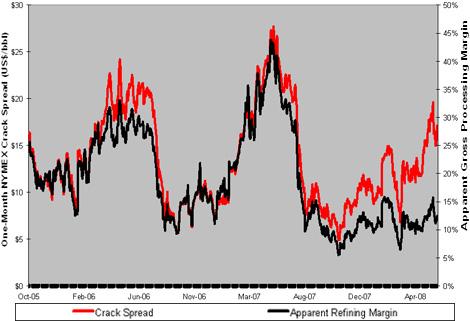
To sum up, here is a graph of the NYMEX crack spread vs. refining margins.


Monday, February 21, 2011

An Interview with Larry Levin

Here is an recent interview with Larry Levin and TraderDaily, there are some good tips and insights in the interview, for those of you don't know him yet, he basically started from nothing, went bust four times and now is a legendary S&P 500 trader averaging 2500 to 3000 contracts on the CME per day.


TraderDaily: In your career, you have successfully climbed the ranks from the bottom to the top of the ladder. Do you think this type of advancement is possible in today’s market, particularly without formal education? What advice would you give to the guys at the bottom trying to follow your lead?
Levin: No, the trading floor was a place where you could start at the bottom and work your way up, or even find an opportunity with a different trading company in the same place (the trading floor).  Back then, it was pretty easy to get an entry-level job on the trading floor, and if you were sharp, you had a chance to get noticed.  Now, you must try to get in with each individual company, and that’s much more difficult.  And without a finance degree, most won’t even talk to you.

TraderDaily: In the mid-1980s, Richard Dennis began his Turtles experiment, where he gave relatively inexperienced personnel a clearly defined trading system and some capital, with impressive results. In today’s markets, are traders born or can they be made?
Levin: Traders are made, not born.  Every trader has to go through the same learning process.  They all must learn from their mistakes, just like you’d learn any skill.  The problem is most people don’t have a Richard Dennis to show them how to avoid the mistakes quickly.  Therefore, people will run out of money long before they figure out how to trade.

TraderDaily: You first started marketing your training program, “The Secrets of Floor Traders,” in 1998. How much has commodity trading — and its secrets — moved off the floor in the years since then?
Levin: The edge used to be gained on the trading floor by seeing institutional orders and learning from other experienced traders.  Today, the edge is to understand technical analysis and how to trade electronically.  There is no edge on the floor anymore.


TraderDaily: Some trading firms like to start with people who have not traded before and, therefore, carry no bias or pre-conceived ideas to the table. Does this kind of approach work today, or are trading firms hiring people with as much experience as possible?
Levin: If the trading strategies are extremely defined, then hiring inexperienced people can work.  But when you ask a trader to think and trade in a discretionary method, then experienced traders are necessary.

TraderDaily: In addition to the S&P 500 index trading that’s been going on for years, many institutional players use index ETFs to take long and short positions. Does heavy trading of ETFs distort the markets they are supposed to track?
Levin: I don’t really think so. Even if they do, it doesn’t really matter, as the market will move the way all traders make it move. Unless large positions are not allowed in the ETFs, it’s just something else that traders have to deal with.  I don’t think about it much.

TraderDaily: A majority of your trading career took place prior to the widespread electronic trading that moves markets today. What’s your take on this evolution? Has it affected you personally?
Levin: I don’t fight it. I took on electronic trading as close to its onset as possible.  It made me a lot of money!  Unfortunately, many traders haven’t made the evolution to electronic trading, and they are struggling.

TraderDaily: Do you think that automated and low-latency trading played a role in the May 6 flash crash, or is that just an attempt to find a convenient explanation for something that is difficult to explain?
Levin: I do think HFT trading is a big part of it.  But this is the world we live in, and you must have stop losses in place on all positions at all times.  Naked positions are the kiss of death.  In all honesty, I don’t know exactly what caused the Flash Crash, but it wouldn’t surprise me one bit to see one happen again.

TraderDaily: A lot of prop traders blow out — you did it four times and managed to get back in the business. Was there a common thread behind your four wipe-outs? What did you learn from them?
Levin: The common theme was that I figured out how to get more money each time I blew out.  I’m a big fan of learning from your mistakes and evolving into a better trader.  The reason most people blow out is that they trade with real money before they know what they are doing.  The key is trading with a simulator until you have the proper skills.

TraderDaily: How did you avoid giving away your edge when you came out with “The Secrets of Floor Traders”?
Levin: The edge is different with each person.  Each trader needs to find what works personally for them (and it can be different for each person).  So you can’t really give it away, you can only help someone find his or her own “personal edge.”

TraderDaily: How helpful are E-mini S&P 500 contracts for traders who are not starting out with a substantial amount of capital?
Levin: They are extremely helpful as they were devised for the small trader in mind.  They allow you to trade a contract that is 1/5 the size of the big S&P 500.  It was the smartest move the CME group ever made.

TraderDaily: What is the biggest single mistake you see new traders make?
Levin: Not using stop loss orders.  It’s how to end your trading career very fast!